Data Spotlight
Reported losses to scams on social media eight times higher than in 2020





The .gov means it’s official.
Federal government websites often end in .gov or .mil. Before sharing sensitive information, make sure you’re on a federal government site.

The site is secure.
The https:// ensures that you are connecting to the official website and that any information you provide is encrypted and transmitted securely.

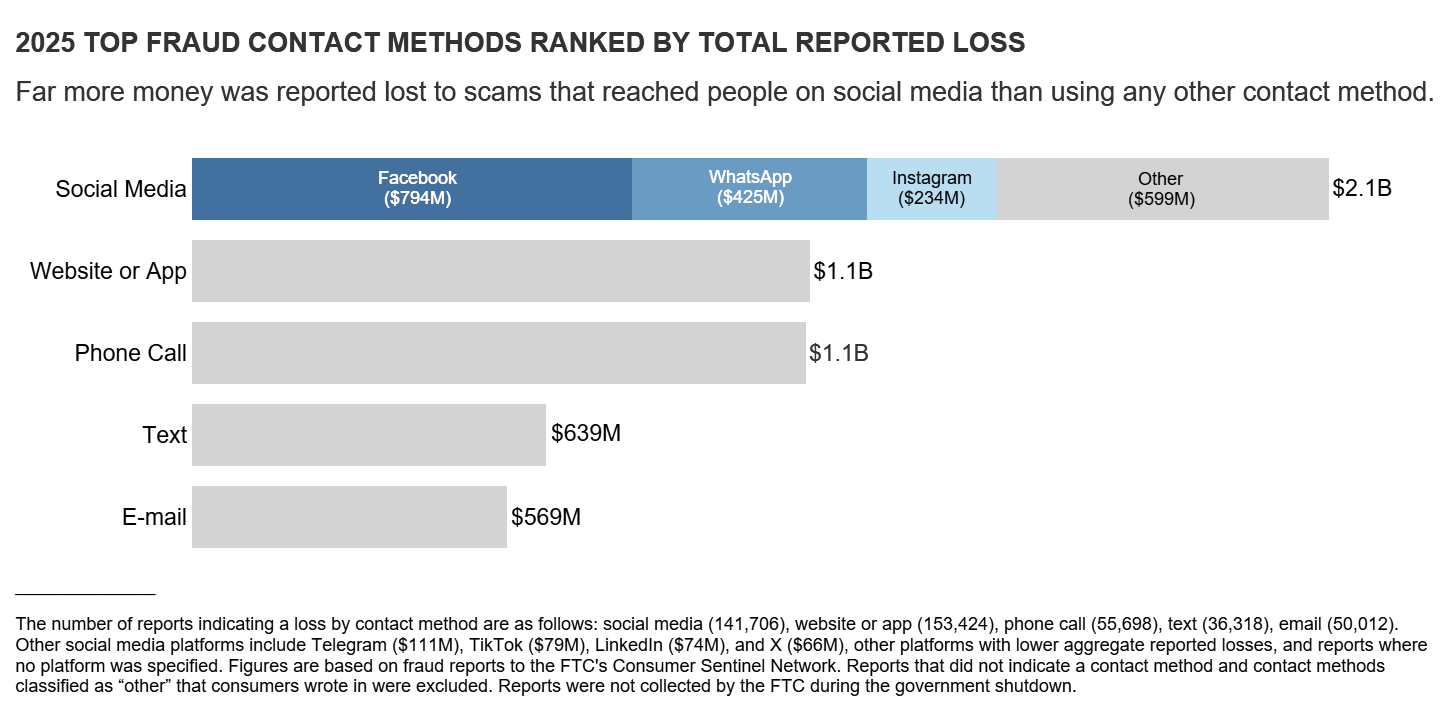
Scammers reach people in many different ways – phone calls, texts, emails – but reports to the FTC’s Consumer Sentinel Network point to social media as a scammer favorite. In 2025, nearly 30% of people who reported losing money to a scam said it started on social media,[1] with reported losses reaching a staggering $2.1 billion. That’s far more than the losses reported to any other form of contact, and about eight times the 2020 figure.[2] And since most scams aren’t reported to the government, the real losses are likely much higher.[3]
Social media can be a great way to connect, but can also make a scammer’s job easier. They might hack into your account to scam your friends or even create entirely fake profiles. Or they might use what you post to figure out how to target you. And by buying ads, they get the same tools real businesses use to target you by age, interests, or shopping habits. At very little cost, scammers can reach billions of people from anywhere in the world.
Last year, shopping scams were the most reported scam on social media. More than 40% of people who lost money to a scam on social media said it started when they ordered something they’d seen in an ad – everything from clothes and makeup to car parts and even puppies. Many ads led to unfamiliar websites, while others sent people to sites impersonating well-known brands offering big discounts. Most people said they paid for things that simply never arrived. When orders did show up, people often reported the items were counterfeits or very different from what was advertised. Reports show that these products were often shipped from China, with high return shipping costs making returns unworkable.
Investment scams, however, caused the biggest reported losses last year of scams initiated on social media. In fact, $1.1 billion,[4] more than half the money reported lost, was to investment scammers. These scams often started with an ad or post offering a program to teach you how to invest. Other scammers posed as friendly advisors or created WhatsApp groups full of “successful investors” sharing glowing—but fake—testimonials. They directed people to fake—but real-looking—investment platforms. There, people create an account, see fake profits, and maybe even withdraw a small amount—this builds trust, so people invest more. But there never was any real investment and, worse still, some people who lost money this way reported secondary losses to scammers who said they could trace and recover lost money…for a fee.
Reports show romance scams also thrive on social media—nearly 60% of people who reported losing money to a romance scam in 2025 said it started on a social media platform.[5] According to reports, scammers often tailored their act based on people’s profiles, later inventing a crisis requiring money or casually offering investment advice to draw them onto a fake investment platform. Other scammers trick people into sending nude photos, then threaten to send the images to their social media contacts unless they pay.
Scams that use social media to target people looking for jobs and housing are another problem. One in three people who reported losing money to a job or business opportunity scam in 2025 said it started on social media.[6] And a recent analysis of reports about fake rental home listings found that about half were posted on Facebook.
Scams on social media affect people of all ages. In fact, social media was the most costly fraud contact method last year in terms of aggregate reported losses for every age group under 80, and ranked second after phone calls for those 80 and over. Where people reported losing money, social media was also the most reported contact method for many age groups, including people in their 60s and 70s.[7]
In 2025, people reported more money lost to scams that started on Facebook than on any other social media platform. WhatsApp and Instagram were a distant second and third. In fact, in 2025 people reported far more money lost to scams on Facebook alone than they reported losing to text or email scams.
To help you steer clear of scams on social media:
To learn more about how to spot, avoid, and report scams—and how to recover money if you’ve paid a scammer—visit ftc.gov/scams. If you spot a scam, report it to the FTC at ReportFraud.ftc.gov.
The FTC uses reports from the public to investigate and stop fraud, for consumer education and outreach, and for analyses like this. File your fraud report at ReportFraud.ftc.gov. To explore Sentinel data, visit FTC.gov/exploredata.
[1] In 2025, the top contact methods ranked by fraud reports indicating a loss were as follows: website or app (31%), social media (28%), phone call (11%), email (10%), text (7%). These percentage calculations exclude reports that did not indicate a contact method and contact methods classified as “other” that consumers wrote in. Reports were not collected by the FTC during the 2025 government shutdown.
[2] The total reported losses on fraud reports indicating social media as the contact method by year are as follows: $261M (2020), $789M (2021), $1.2B (2022), $1.5B (2023), $1.9B (2024), $2.1B (2025). Reports were not collected by the FTC during the 2025 government shutdown.
[3] See Anderson, K. B., To Whom Do Victims of Mass-Market Consumer Fraud Complain? at 1 (May 2021), available at https://papers.ssrn.com/sol3/papers.cfm?abstract_id=3852323 (study showed only 4.8% of people who experienced mass-market consumer fraud complained to a Better Business Bureau or a government entity).
[4] In terms of aggregate reported losses, romance scams were a distant second, with $298M reported lost to romance scams originating on social media in 2025.
[5] This percentage calculation excludes reports that did not indicate a contact method and contact methods classified as “other” that consumers wrote in.
[6] Ibid.
[7] In 2025, excluding reports that did not indicate a loss, social media was the top contact method reported by ages 18-29, 50-59, 60-69, and 70-79, the second most reported contact method after website or app for people ages 30-39 and 40-49, and the third most reported contact method after phone call and website or app for people 80 and over. The share of loss reports about scams originating on social media by age group was as follows: 40% (18-29), 32% (30-39), 32% (40-49), 32% (50-59), 29% (60-69), 23% (70-79), and 14% (80 and over).This excludes reports that did not indicate a contact method and contact methods classified as “other” that consumers wrote in.